
Temple Vastu: The Ancient Science of Sacred Architecture
Vastu Shastra for temples (often referred to as Shilpa Shastra) is an intricate architectural science designed to make the temple a “living” organism that vibrates with divine energy.
Here are the detailed principles of Temple Vastu:
1. The Vastu Purusha Mandala
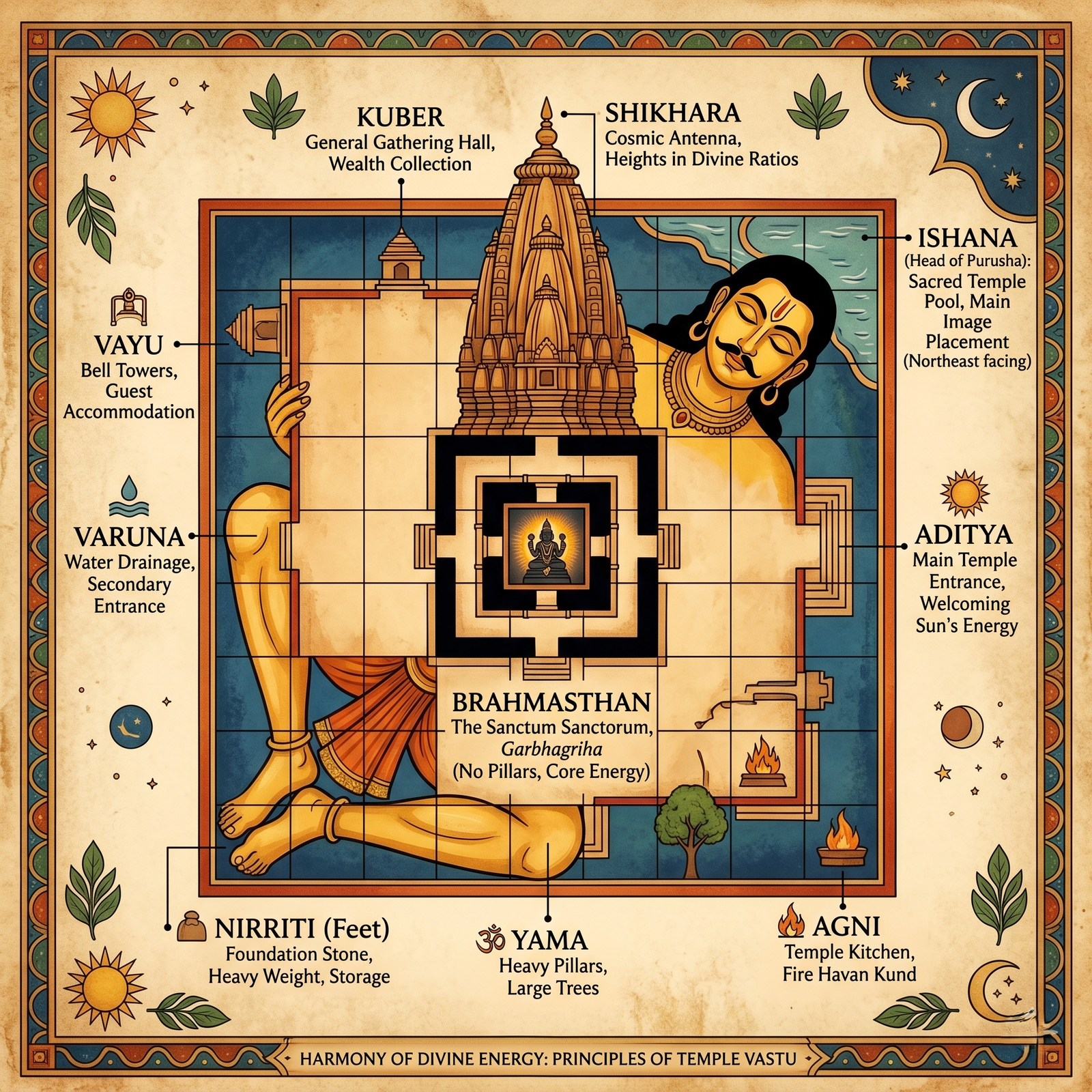
The most critical element is the Mandala, a sacred mathematical grid. The most common form for temples is the Paramasayika Mandala, an 81-square (9×9) grid.
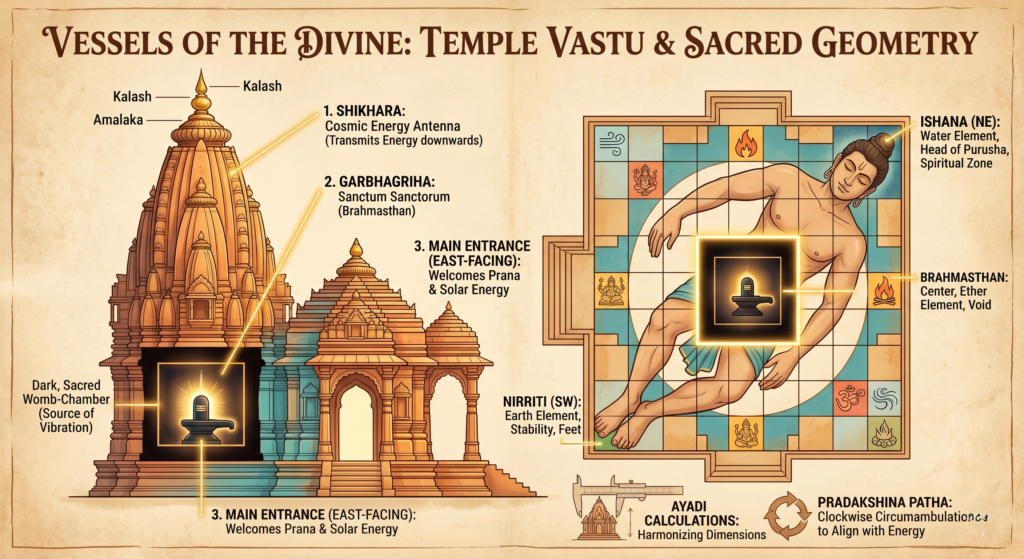
- The Center (Brahmasthan): This is the core of the temple where the energy is most concentrated. This is exactly where the Garbhagriha (Sanctum Sanctorum) is placed.
- The Purusha: The “Cosmic Man” is depicted lying face down in this grid. His head is in the Northeast (Ishana), and his feet are in the Southwest (Nirriti). Architects ensure no heavy pillars or walls “pierce” the vital points (Marmas) of this cosmic figure.
2. The Garbhagriha (Sanctum Sanctorum)
This is the “womb-chamber” where the deity resides.
- Shape: It is usually a perfect square.
- Environment: It is designed with thick walls and no windows to minimize external sensory distractions. This creates a “cave-like” silence that amplifies the vibration of chants and bells.
- Lighting: The only light should traditionally come from oil lamps, focusing the devotee’s attention entirely on the idol.
3. The Shikhara (The Mountain Peak)
The Shikhara is the spire that rises above the Garbhagriha.
- Function: It acts as a spiritual antenna. Vastu dictates that the height of the Shikhara should be in a specific ratio to the width of the sanctum (often double the width).
- The Kalash: At the very top sits the Kalash (metal pot) and the Amalaka (stone disk). These elements are believed to conduct cosmic energy down into the idol through a central axis called the Brahmasutra.
4. Directional Alignments
- East-Facing: Most temples face East so that the rising sun’s first rays can fall on the feet of the deity.
- Entrance (Gopuram/Mahadwara): The main entrance should be grand and positioned in an “Exalted” (Ucha) zone of the Vastu grid to invite positive Prana (life force).
- Circumambulation (Pradakshina Patha): Vastu requires a walkway around the sanctum. Devotees walk clockwise, which is believed to align their personal energy field with the temple’s magnetic field.
5. Water Elements
A temple is considered incomplete without a water source.
- Location: Water tanks (Temple Tanks) or wells should ideally be located in the Northeast corner.
- Significance: Water represents the element of “Akasha” (Ether) and “Jala” (Water), which purifies the devotee before they enter the sacred space.
6. The Choice of Material
Vastu classifies stones and wood into “Masculine,” “Feminine,” and “Neuter” categories:
- Masculine Stone: Used for the main deity (hard, ringing sound when struck).
- Feminine Stone: Used for the pedestal or female deities (soft, dull sound).
- Neuter Stone: Used for the foundation and walls.
7. The Concept of “Ayadi” (Mathematical Calculations)
Before construction, architects use six formulas called Ayadi Shadvarga to ensure the temple’s dimensions are in harmony with the patron (Yajamana) and the deity. These calculations determine:
- Aya (Income/Gain): Ensuring the temple brings spiritual prosperity.
- Vyaya (Expenditure): Ensuring the energy is not wasted.
- Yoni (Direction): Determining the flow of energy.
- Vara/Nakshatra: Aligning the building with the lunar and solar calendar.